Saturday, April 15, 2023

4 New Books By Friends

 In the last few months, a number of friends have written and published books. Most were self-published, and some of them I read in early drafts to give feedback to the author. I know all of these women in real life. Some I only met once, and others I've known for many years.

Unless I state otherwise, I purchased these books myself. I love shopping on Amazon and the convience of ordering a pack of socks, a washing machine part, and a bottle of vitamins in a few minutes. But books written by my friends are one place I splurge and either buy directly from the author or from small Mennonite book stores. I love knowing that the author is getting a reasonable return on their investment of time and hopefully it encourages them to write more books. 

I'll include ordering information directly from the author or from their distributor. Or, if you live in a Mennonite community, ask for these books at your local bookstore or fabric store.


A Time to Heal by Emily Steiner

For those who have followed Justin and Monica in the Time trilogy, this is the final book of the trilogy. In this book, book Justin and Monica cross the ocean - Monica to Ukraine and Justin to Ghana where they face the challenges of a new culture, new language, and new co-workers. Emily, the author, visited Ukraine before the war, and added flavor that could only come from someone who experienced the culture firsthand. 

Emily's books include characters with flaws and strengths that feel realistic. If you want to know what it is like to be an older single in a Mennonite setting, this series will give you an inside peak.

You can purchase A Time to Heal from Emily Steiner for $14 each with $3.50 shipping for the first book and $1 for each additional book. Contact Emily at  jemstyle01 @icloud.com and ask to be added to her email list to hear about future books.

Student with Seven Teachers by Sarah L. Martin

I met Sarah a few years ago by email, then later met her in real life. Since then, we talk often. Our children are similiar ages, and I've enjoyed the regular emails she sends sharing the everyday life of a mom of seven in Eastern Ontario. 

Sarah compiled almost 70 of her essays into a book for moms. This is the kind of book I would have enjoyed reading when I was nursing a baby. The accounts are short, but the reader gets to follow along as Sarah learns about God and life from her children. Sarah is in the challenging stage where her children stretch from teens spreading their wings down to pre-schoolers.

Sarah's book was given to me by a friend, and I recommend it for a gift for any mom who needs to hear from a fellow mom reaching for grace in the middle of the crazy mom years.

Student with Seven Teachers is distributed by Living Waters Bookstore which has distribution points in both Ontario and New York and can mail books to both Canada and the US.

Edit: It looks like the link for the Living Waters website is in Canada which gives very high shipping to the US. To call their US office, you can try this number 1-888-932-0209. You can also purchase Student with Seven Teachers and probably most if not all the other books in this post from Faith View Books. They don't have a website to order but they have a great print catalog and helpful phone ordering.

Bargains for Blisses by Darletta Martin

Darletta was a teacher at a small conservative Mennonite school and is writing a series set in a similiar small school. If you want a real glimpse into a Mennonite culture (instead of the Amish romance books written by authors who have never been Amish) here is a good series for you. 

Bargains for Blisses is the second in the Creekside Characters series, the sequel to Nothing So Kingly. Each chapter follows a different teen as they struggle through the normal challenges of growing up and interacting with their parents, siblings, and friends. I like that a wide variety of homes are depicted, as well as teens with different hobbies and dreams. My fourteen-year-old is the perfect target age for this series.

You can purchase Bargains for Blisses from Darletta (dgdfmartin @daystar.io) for $9.99.

Tricked on the Tracks by Katrina Hoover Lee

If you have read any of the previous books in the Brady Street Boys series, you know this is an action packed series, following three brothers who live along the river. In Tricked on the Tracks, Gary is still searching for the doctor that removed his leg many years before. Clues lead the boys to a hobo camp along the railroad track and gives the boys an unexpected adventure in a boxcar. 

I describe this series as a cross between the Hardy Boys and the Sugar Creek Gang. Not as preachy as the Sugar Creek Gang, but more inspirational than the Hardy Boys. Set in the 80s, this series gives a refreshing glimpse of life before cell phones, though a cell phone would have come in handy when the boys were trapped in a train car. 

When I read them aloud to my girls, they beg for "just one more chapter" and unlike some books, I don't mind reading more myself.

You can purchase all the books in this series at Katrina's website (affliate link). You can read more of her writing on Katrina's blog or sign up to recieve her weekly emails. 


I have more books by friends to share, but maybe I'll save them for another post. But I will also mention that the newest edition of Motherhood is available. 

Issue 4  of Motherhood focuses on God's faithfulness. I help to edit Motherhood, and I was inspired by the stories of God's faithfulness to mothers in various stages of life. This is a full-color, coffee-table type book with lovely art work and photography. These issues have been going fast, so to get your copy, go to the Motherhood website. If you live local to me, I have copies available at my house for purchase. This makes a perfect Mother's Day gift.

Saturday, April 8, 2023

On Selecting Reading Material

I wasn't the only one who wishes to learn to read slowly. I loved connecting with a number of you on this topic, both in real life and by email. And some of you left some great thoughts in the comments of the last post. 

Bethany said that she did a book reading challenge last year to encourage herself to read more deeply in physical books.

Beverly says that she is writing out Scripture in cursive as a way to slow down and think on what she is reading, and Dee says she is paring down her online reading to only a handful of sites that truly builds her walk with God.

Mary Kathryn gave some specific poetry recommendations, and Jessica says that she found that she enjoys children's poetry best.

I've been thinking more about why I didn't think I liked poetry. I know that part of the reason was that I was trying to consume it too fast, to bolt it down. Poetry is like cheesecake. It must be eaten slowly and savored. While a novel can be inhaled in an afternoon, doing the same with poetry gives indigestion. 

But also, when I've tried reading poetry, I liked some poems, but not nearly all, so I thought I didn't enjoy poetry.

What kind of crazy thinking is that? Why did I think I didn't like poetry just because I didn't like every poem that I read?

When I walk into a library or bookstore, do I like every book? Of course not. I have no desire to read most books, either because of the content or the style. But I don't decide that just because there are many books that I don't like, I don't like books. If I read a novel I don't like, I don't decide I hate all fiction. If I read a biography I don't like, I don't decide I hate all biographies. 

I have no desire to read most of the hundreds of thousands of books published in the US this year, even if I could. Over the years, I have learned to evaluate the books I read and figure out what kind of books I most enjoy so that I can select more books that I enjoy. 

Take a genre such as fiction. There is a lot of fiction that I dislike, but there are some I love. When I find one I like, I try to find more books like it. That may mean looking for more books by the same author. Or books that are listed as similiar to the one I liked. I've also paid attention to friends who like the same books that I do and ask them for recommendations. As I learn more about my own reading tastes, I spend less time reading books that aren't a good fit for me.

Maybe I need to change the way I look at poetry. Maybe, like other genres, I won't like most of what is published. But maybe I can find a few authors I enjoy. Or ask friends with similiar tastes for recommendations. Maybe I can discern what style of poetry I most enjoy. 

The good think about poetry is that it is short so if I do read a poem that I don't enjoy, I've not wasted a lot of time. I've decided that I like poems that I can understand, that I can find meaning in, yet aren't trite. I want some element of surprises or impression of "Me, too!" when I read a poem. I want to feel some kind of emotion such as sadness, conviction, joy, or gratitude. I don't want to be completely bewildered. I've read poems and thought, I understand every word but don't have a clue what the author is talking about.

I think I prefer modern poetry toward old classics. And maybe that makes sense. We don't hand A Tale of Two Cities or Moby Dick to a beginning reader. Maybe I need to strengthen my poetry reading muscles before I can take on Milton or Keats.

I don't like poems where the rhyme and rythym feel forced. In some poems, I found the word choices distracting. (Why did they use that word 'vain'? Oh, I guess they had to find a rhyming word for 'rain.' Insert eye roll.) 

For a while I didn't think I liked metered rhyming poems. Free verse may still be my favorite, but when I read a poet such Malcom Guite, I don't think about rhyme or meter. So maybe it has more to do with the skill of the writer. Some writers carry me along on the words with no jarring distractions just to find a rhyme. This is what I'm looking for in a poem. (And maybe if I'd try writing poetry I'd have more compassion for the poems that feel contrived. I'm sure producing quality poetry is intensely difficult.)

For me, finding that there are specific poems I like and acknowledging that, like most genres, I won't like most poetry, has helped me enjoy poetry more. 

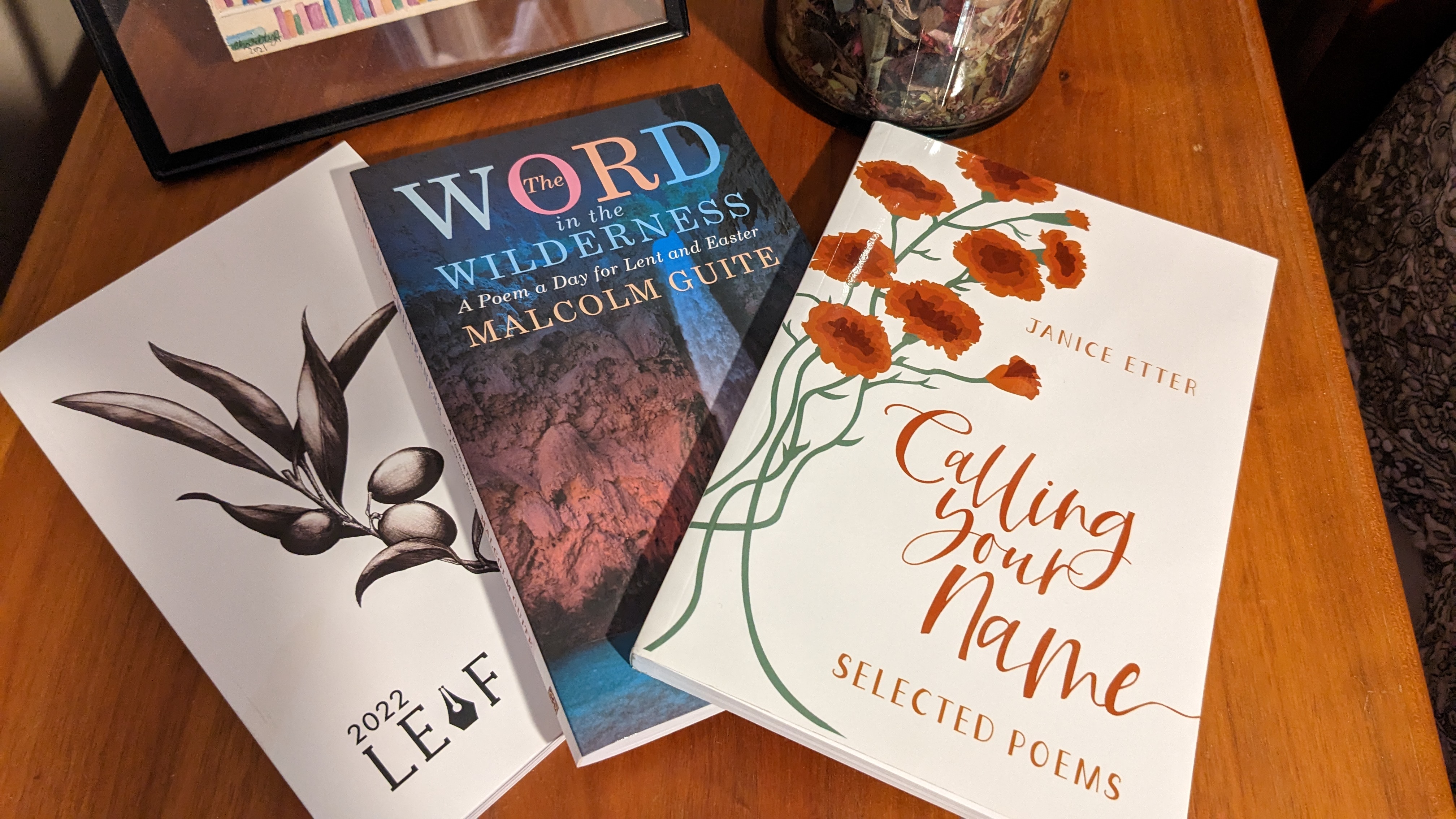
And though I said I didn't really enjoy poetry, I realized that I currently have three poetry books on my bedside table. One was a gift, one is borrowed, and one I bought. These three have been there for a while, as I dabble in them slowly.

I've already mentioned Word in the Wilderness, compiled by Malcolm Guite. Calling Your Name by Janice Etter is from a talented German Baptist writer from Indiana that I met once. Leaf 2022 is published by The Curator with new poetry and a few prose pieces from Anabaptist writers.

Want to read a bit of poetry? I recommend The Curator website and Malcolm Guite's website for places to start. You probably won't like everything, but maybe you'll find one or two that you do enjoy.

Saturday, April 1, 2023

Why Read Slowly?

For years, I wished that I enjoyed poetry. I loved words and stories; I thought I'd should enjoy poems too. But when I read a book of poetry, I quickly became frustrated. Reading a book of poetry was so different than reading fiction or nonfiction. I decided that I must not like poetry. 

But I kept trying. I picked up poetry books at used book stores. I read poems to my children. The last couple years, in the month of April, several of my siblings and I exchanged poems on Whatsapp. I enjoyed some poems, but sometimes it felt like swallowing my vitamins.

I've also noticed a disturbing trend in my reading. Impatience. 

Maybe I can blame it on our instant gratification culture. Technology allows knowledge to be gained with little effort. I've become good at skimming websites for information, immediately skipping to the next relevant post in the Google search. I could feel my attention span decreasing. When listening to an audio book or podcast, I pushed up the speed, hyper-listening. More words, more chapters, more content in less time.

I found myself craving slowness. I wanted to linger, to savour, to treasure, not gulp, guzzle, and cram. I wanted to fight against a culture that said more and faster is always better.

In anticipation of the busy holiday season last year, I decided to take a stand against our frantic frenzied culture and purchased Malcolm Guite's Advent poetry collection, Waiting on the Word. (This post contains affiliate links.) Each day I read one poem selected or written by Guite and read his short commentary on the poem. I had to read each poem more than once to extract the meaning. I still didn't think I was great at reading poetry. I didn't know if I even liked poetry. But I did like what slowing down, reading carefully, and rereading was doing for me. 

I enjoyed it so much that I bought Guite's Lent and Easter poetry collection Word in the Wilderness. I don't observe Lent as a spiritual practice, but I'm enjoying this collection of poems on the life, death, and resurrection of Christ. 

Was it just happanstance that this winter I purposely began to practice slow Bible reading?

Last year I read through the Bible in a year, which I enjoyed because it gave me the wide-angle view of the Bible in a big swath. But I felt like I was galloping through the prairie. I wanted to slow down and look for wildflowers. I didn't want to skim read. I wanted to camp out under one tree for a week and count the ants and acorns. 

I wondered if my habit of skim reading online, of listening to audio books in double speed, was ruining my ability to read God's Word deeply. How can I follow God's command to meditate on His Word when I'm rushing to complete my chapter for the day to fill my brain with the next bit of noise?

So my Bible reading this year as been slow and deliberate. I spent weeks in the book of Habakukk, reading and rereading the verses. I worked through the Kingdom of Priests Bible study published by Daughters of Promise. I have taken one passage and turned it over and studied each side. Then did it again the next day with the same passage. 

Is there a connection between my goal of reading poetry and my deliberate practice of slow Bible reading? Can I train my brain to focus, just as I once urged my brain to speed read? Speed reading may have value, but right now I'm relishing slow and steady, deliberate and thougthful.

April is National Poetry Month in the US and Canada. (Who comes up with these designated days? Well, a quick search found that this one was begun by the Academy of American Poets, a nonprofit who attempts to encourage the reading of poetry.)

Want to join me in some slow reading? Do you, like me, want to use poetry as a way to build a habit of reading more deliberately? I hope to talk more about poetry this month, but I'd love to hear from you. How do you fight against the instant culture? Have you chosen any specific practices to slow yourself down and think deeply? 


Thursday, March 9, 2023

Sisters' Bright Winter Reading in February

 Charity and I enjoy the Brighter Winter reading challenge each year. We both read lots of great books, but here are a few of books we especially enjoyed in February. 

This post contains affiliate links.

Charity - Read a book from a tumultuous time in history

The Last Bookshop in London by Madeline Martin

This novel is set during World War 2 in London. The main character moves to London and begins working in a small bookshop right before the Blitz begins and found that books can be a haven during hard days. I was inspired by the power of stories to bring hope even during hardship. 

Gina - Read a book by someone who shares your initials

Reaching America by Gary Miller

A few ladies from my church read and discussed Reaching America last month. Miller delves into the changes in religious understanding in the American popultion and why traditional witnessing may not bear as much fruit as in pass generations. His book shows practical ways to reach out to our neighbors and gave examples of how to interact with people who are searching for meaning in their lives. Our evening of conversation around this book was inspiring and challenging.

Charity - Do a blind book exchage with a friend

Placemaker by Christie Purifoy

Gina chose Placemaker for me, in which the author weaves together the stories of her homes, past and present. She challenged me to make our homes beautiful, welcoming, and life giving. I found myself lingering over the masterful way she writes and clinging to the beauty of the words.

Gina - Blind book exchange

Gay Girl, Good God by Jackie Hill Perry

Charity gave me Gay Girl, Good God. I expected it to be a story of conversion to a life serving Jesus Christ - and it was. But I was pleasantly surprised that Perry emphasized the character of God. I love that God's mercy and redeeming power shined in this book.

What were the highlights of your winter reading?

Wednesday, March 1, 2023

Sisters' Spring Reading Challenge

With the Brighter Winter reading challenge over, Charity and I are beginning our seasonal reading challenge again. We are both looking forward to diving into some of the books that have been on our shelves. Want to join us?

This post contains affiliate links which add no additional cost to you.


Sisters' Spring Reading Challenge

1. Read a book that is longer than your average read. 

Here is a chance to tackle a book that is daunting because of its page count. Maybe you'd like to tackle a long classic like Les Miserables, Bleak House, or The Lord of the Rings. Maybe you are drawn to nonficiton like Truman by David McCullough or a modern novel such as All the Light We Cannot See by Anthony Doerr but haven't wanted to commit to a longer book.

If you start a book today and read a chapter or so a week, by the end of May, even if you haven't completed the book, you would have made headway. 

2. In honor of Charity's anticipated motherhood, read a book about motherhood or a book that has a mother as the main character.

Examples: Missional Motherhood, A Garden to Keep, Little Women, Stepping Heavenward, Anne of Ingleside, Mary Emma and Company. And now I have a problem because I'd love to reread all of these books.

3. Choose a bookshelf (in your house, the library, or your friend's house), count the fifth book from the right and read it. 

I have a whole shelf of books that I want to read, so hopefully this will help me decide which book to read next. 

Make this challenge fit you. If you don't care to read the first book you select, find another bookshelf!

4. Choose a word or phrase in the Bible and look up five or so verses that contain that word and read them in context. 

Example: peace, joy, tree of life, light, kingdom of heaven

Looking forward to a good spring of reading.

Saturday, February 18, 2023

Traditions and Doughnut Day

I've been thinking a lot about family traditions. How are traditions different from routines and habits? I think of a traditions as a way that we celebrate holidays and special days. What happens when life shifts and traditions are forced to change? How much value should be put on traditions?

You probably expect that I'm thinking of this topic since losing Ed, and you are right. But I think that the loss of Ed upended routines and habits more than traditions. Actually, Ed and I didn't have many traditions. Someone asked what we did on Valentines' Day, and I had to dig deep in my memory. While I remember various ways we celebrated the holiday through the years, we didn't have a specific tradition. Same goes for birthdays and aniversaries.

Traditions are fun. It doesn't take young children long to build a tradition. Do something once or twice and I hear, "We always...." Even though I've struggled to build traditions like for the first day of school or on birthdays, we still have acquired a few traditions along the way.

This week, for the first time, my children and I are taking a trip without my two oldest children. (We plan to spend a week helping rebuild houses after a flood, but my two oldest children are going another week with friends.) This is the fifth winter we've done this, but it won't be the same. And I'm okay with change - most days. Some change show maturity and growth - in myself and my children. I need to let go some of my expectations and allow my children to grow and change.

This past year, my mother-in-law sold her house and moved to a nursing home. My parents moved out of their big farmhouse six years ago. And, of course, Ed's death brought a huge number of changes to our home. Aging and death bring change which carries a lot of grief.

If you are a long time reader here, you know that for years my family made doughnuts every winter. I don't know when this tradition started. My first memory of doughnut making was when I was a very small girl. As my brothers married, their wives joined the doughnut making tradition. Sometimes we'd make doughnuts on Fasnacht Day; sometimes we'd choose another day.

In 2016, my family made doughnuts at my mom's house, not realizing it would be the last time. (We even had a photographer from the local newspaper record the event. The next year, my parents would move out of the farm house. The day had gotten rather crazy anyway, with so many children, and maybe it was simply time to adjust this tradition. So Ed and I spend a Saturday making apple fritters at our house. I thought maybe that would be the start of a new tradition. But months later, Ed was diagnosed with brain cancer, and we never again made doughnuts. 

This winter, we were discussing doughnuts, and I realized that my two youngest girls didn't remember doughnut making at all. I shouldn't have been surprised. At that last doughnut making at my mom's house, my youngest daughter had only been a few weeks old. 

So I asked my mom if she would bring her fryer to my house to make doughnuts. I invited two of my sisters, and we had a fun doughnut day, seven years after our last one. 


Will this begin a new tradition with my daughters? I don't know. Maybe this will be a one-time event that my girls will look back to and say, "Remember that time we made doughnuts?" Maybe some day they will bring their children and say, "Every winter we go to mom's house and make doughnuts." 

What traditions have you had to change? Have you replaced it with new ones?

To read more on past doughnut days...
Mom's doughnut recipe - we have used the same recipe for over 30 years.
Apple fritter recipe - the new favorite
What happens when your memory fries on doughnut day

Friday, February 3, 2023

Sisters' Bright Winter reading in January

I have more to life than just reading, though you might not know it from this blog. January was a full month, including our family butcher day, a trip to North Carolina for a wedding, a delightful writing day with three friends, and lots of the daily activites of homeschooling, laundry, and food prep. All these things might be worthy of writing about, and maybe I will, but somehow my time this winter is consumed by projects besides blogging. 

But some of you keep saying you enjoy our book reviews, and book reviews are some of the easiest things to write about, so here are a few more.

This post contains affiliate links.


Charity and I are both taking part in the Brighter Winter reading program. This has been a favorite part of our winter for the last several years and always helps to stretch our reading into new genres. 

Both of us completed all twenty grids in January, and here are a few of our favorite reads this month. 

Charity -

Read a green book.

The Code of the Woosters by P.G. Wodehouse

Wodehouse is the author of comical British novels. In this book Bertie is once again tangled up in his friends’ affairs, trying to help and getting into trouble. The cast of characters is hilarious, and I loved Bertie’s valet, the calm, measured, and always-coming-to-the-rescue Jeeves. I listened to an audio version and the British accents make the story even better! 

Read the last book published by a author.
Read a classic you think you "should" have read before.

The Mystery of Edwin Drood by Charles Dickens 

At Dickens’ death, he left one book incomplete. Now I will always want to know the ending to this mysterious story, such as did Drood actually die, is John Jasper hiding something, will Rosa every feel safe again, and who is the stranger that watches Jasper? It is a beautifully written story with intricately drawn characters. If Dickens had completed this book, it would have been a masterpiece.

Gina - 

Read a medical memoir. 

Being Mortal by Atul Gawande

I have heard of this book for years, but this challenge finally pushed me to read it. Gawande explores the topic of aging, the elderly, and ultimately, death. This isn't a fun subjects to read about, but by the time I finished reading this book I thought that anyone who loves an older person or will one day become an older person, should read this book. In other words, everyone. Gawande looks at nursing home options, end-of-life decisions, the role of communication, and much more. Probably what makes this book so valuable is that Gawande isn't looking at it as a researcher. He tells the story of his own patients, and then his own dad, showing that he has wrestled deeply with these questions himself. 

Read a nonfiction book by a female Christian writer.
Read a green book. 

Humble Roots by Hannah Anderson

This book seems simple, just a book sharing garden analogies on humility. With Jefferson's grapevines and her own herb garden plus more as examples, Anderson shows that humility is the fruit of belonging to Jesus. I'm finding myself thinking about the book a few weeks later, which is a sign of a book that I read at the right time.

Do a buddy read. 


One of the reading challenges was to read a book with a friend so you can discuss it together. Charity and I chose The Great Good Thing. In this memior Klavan shares how God slowly drew Klaven to Himself from a life totally devoid of God. I don't think I've ever read a conversion story like it and though I might not agree with all of Klavan's beliefs, his story made me love our Savior even more.

Do you read more in the winter? What was your favorite book in January?

LinkWithin

Related Posts with Thumbnails