Showing posts with label chickens. Show all posts

Friday, January 4, 2013

Question: Winter Egg Laying


This photo was taken on the first day of winter. 

What is so exciting about a bowl of eight eggs? Because these were the eggs laid on the first day of winter. Eight eggs - and we only have eight chickens. On the shortest day of the year, each chicken laid one egg. 

And it wasn't a fluke that happened only one day. The day before and the day after we also gathered eight eggs. Occasionally we'll get only seven eggs, but most often eight. 

This year we have the general sex link hens who are bred for maximum egg laying. Other years when we had heritage breed chickens, they laid fewer eggs per chicken but still did well at egg laying in the winter.
Now you are wondering what is the big deal?

Well, I've been told repeatedly that hens will slow their egg laying when the days shorten unless they receive supplemental lighting. But we don't have current to our hen house. Our hens receive no extra light or heat. Our weather the past two weeks has been cold enough to freeze their water overnight. One morning it was 11 degrees, but still these hens faithfully give us eight eggs a day. Typically we let our hens outdoors for part of each day but our hens are not excited about walking in snow! Our rooster won't even go out at all!

We did cut large windows in the chicken coop. The windows are low enough to shed light right into the hens. 


My husband read in one of Gene Logsdon's books that the whole theory of hens needing supplemental lighting to lay eggs in the winter was made up by the electrical companies in the early 1900's. According to him, farmers in rural America didn't think they needed electricity. In desperation for more customers, farmers were told that they would get more eggs if they supplied their hens with light in the winter months. Logsdon says that extra light is not needed.

I'd like to hear what you have experienced. Do you give your hens light?  Do you consider it necessary?  Do you agree with Logsdo's view of that the need for extra light is a legend?

Friday, September 7, 2012

Freedom Ranger Wrap Up

The Freedom Ranger chickens were ten weeks old this week. They continued to be healthy and alert. They had grown enough that they were a little crowded in their pen, especially when they see us walk out in the morning and all crowd to the one end in anticipation of their feed. I wish we could have left them free range, but we were worried about predators. At least in this pen, we could move them to fresh grass several times a day.


This week was B-Day. And here is where I prove what a sissy homesteader we are.

To butcher our chickens, we loaded them up in crates and took them to a neighboring farm. A couple hours later I picked up beautifully cleaned chickens packed in ice. Maybe someday we will attempt to butcher our own chickens, but at our stage of life, spending two dollars a bird to have someone else do the work is money well spent!


This was our first time to try the Freedom Ranger breed - thanks to an offer from Freedom Ranger Hatchery to try out their chicks. While they gave us free chicks, all the opinions written here are my own.

If you want a comparison - here is the post telling about our chicken raising experience with Cornish Cross last year.

Last year we raised 21 Cornish Cross chickens for eight weeks. Our cost were almost identical to raising 23 Freedom Rangers for ten weeks. (We started out with 26 chicks and three died the first few weeks.)

The biggest difference was size. While at eight weeks the Cornish Cross averaged 5.5 pound, the Freedom Rangers were slower growing. Even at ten weeks the average size was almost four pound, 3.9 pound to be exact. Maybe we should have allowed them to grow longer before butchering, or since we are still newbies, maybe we should have done something different in our feeding to gain greater size.


But I expected a size difference. If you have ever raised Cornish Cross you know that about all they do is hang their heads in the feed trough and eat. The Freedom Rangers ate heartily when we poured feed in the trough but they also nibbled at grass, watched the cat walk across the yard, and in general appeared to be interested in life around them. More than once, when I was filling their water, they pushed against the wire and escaped, capering around the yard before we could capture them again.

Our average cost per chicken was $8.58. This includes feed and butchering. The average price per pound was $2.20. Since I know that local free range chickens often sell for $12.00, I was pleased with our results.


Now for taste. I have heard often that Freedom Rangers taste better. I popped a chicken in my dutch oven, surrounded it with potatoes, onions, garlic, and carrots and threw on some seasonings. A few hours later, the house smelled wonderful.

I really don't know if Freedom Rangers taste better than Cornish Cross. I'd have to do a side-by-side comparison. But recently I had brought some chicken at the store to hold us over until these were ready to butcher. Ed took one bite of our own chicken this week and said there was no comparison to store chicken meat. The chicken was so tender and flavorful with no red streaks along the bone.

The fulfillment of raising your own food make all the frustration worthwhile!

Thursday, August 9, 2012

Freedom Ranger Chicks - Six Weeks

It is hard to believe...


that in six weeks, chicks can grow from tiny balls of fluff...


to lanky adolescents.

Two weeks ago, we moved the Freedom Ranger chicks outside in a movable pen. We move them onto fresh grass three times a day. You can almost see their excitement when we come out to move their pen and they instantly start pecking at the grass. I spotted one with a grasshopper the other day.


I would love to give the chicks more room to roam; we have plenty of pasture. But last year we had a lot of predator problems and I think they are safer in an enclosure.

We have lost three chicks so far. We are not sure exactly what happened to any of them, but one chick found a piece of string, tried to swallow it, and apparently choked himself.


So far, we are very pleased with the growth of the Freedom Rangers. To learn more about Freedom Rangers, visit the Freedom Ranger Hatchery.

Friday, July 13, 2012

Freedom Ranger Chicks at Two Weeks

Our Freedom Ranger chicks from Freedom Ranger Hatchery are now two weeks old.


We have not lost any of them and they are all healthy and active.

In fact, they are so lively that it was hard to take their photo. They wouldn't stop for even a second.


I've been feeding them some old lettuce from the garden. The children say they act like it is candy. They come running as soon as we throw it in their pen.


The chicks tear off pieces and run into the corners to eat it.


In a few minutes, the lettuce is all consumed.


It has been nice having chicks in the summer. We have had hot weather and have only been turning on the heat lamp at night when it drops to 70 degrees. Now that they are starting to feather out, we have stopped using the light at night all together.

We are hoping to move them out to a moveable pen on pasture in a week or two.

Those of you who pasture meat chickens, at what age do you put your chicks outside?

Thursday, June 28, 2012

Freedom Ranger Chicks

Today the phone rang early with news that our chicks had arrived at the post office! There was no problem persuading the children to dress quickly and gulp down breakfast so we could pick them up.


Last year we raised meat chickens for the first time. We chose the basic Cornish Cross chicken breed. Though the Cornish Cross did well for us, we were interested in trying the Freedom Ranger breed of chicken.

From what I've heard, the general opinion is that Freedom Rangers act more like a chicken. They scratch, they run, and they are excellent grazers. Freedom Rangers often have few leg problems and some people even claim the meat tastes better.


On the other hand, as anyone who has raised Cornish Cross knows, those birds were bred to eat and put on weight. Though we raised our chickens last year in a moveable pen and gave them fresh grass several times a day, the Cornish Cross laid on their bellies with their heads in the trough and ate.

This spring, the folks at Freedom Ranger Hatchery (a Mennonite family and a reader of this blog!) offered to give us some Freedom Ranger chicks to try out the breed for ourselves.


Today, 26 one day old chicks arrived from the the Freedom Ranger Hatchery. Located in Pennsylvania, they ship all over the US and the chicks arrived in the mail in great shape.

Within minutes of being introduced to their new home, the chicks were running around, picking feed, and drinking water.


Our children are having wonderful fun with the chicks.

Thanks Freedom Ranger Hatchery for the opportunity to try your chicks.

I'll keep you all posted on our opinion on raising Freedom Rangers. And in the meantime, I'd love to hear your experience. Have you raised meat chickens? Have you tried Freedom Rangers?

Friday, July 8, 2011

It is a Rough World

It is not a good week on the homestead.

Last Friday, we had a flock of laying hens, a beloved rooster, a pen full of meat birds, eight week old future hens, and a hen setting on eggs.

A week later, we have basically nothing left. The meat birds are in the freezer, thankfully. The hens that have survived the predator attack are at my parent's farm. Everything else is dead.


I've dreamed for years of hatching our own chicks. It was one of the main reasons I chose to get some heritage breed chickens. But last year, though a few attempted, none of the hens successfully hatched. When we got new layers last year, I saved my two favorite heritage hens even though they were not laying well.

This spring, the speckled sussex hen began setting. I didn't even know if her eggs were fertile. But yesterday the four eggs began to hatch.


We watched them all day and last evening, two chicks hatched. But when we found them, one was dead and the hen pecked at the other chick. Was the hen rejecting her own chicks? Hopes of the hen caring for her chicks were dashed. We would get out the brooder lamp.


We brought the live chick inside and the children enjoyed playing with it.


Soon another chick hatched. He was still partly attached to his shell and wet.


The last egg was partly cracked so we brought it in under the brooder light and were able to watch it hatch.


What fun! I think I enjoyed it as much as the children. It was amazing to see it emerge from the shell and then turn fluffy. Three chicks wasn't many but I was excited about building a new flock, especially since they were the descendents of our favorite rooster.

The chicks were chirpy and active last night, but this morning they were all dead. Were they too warm? Or too cold? Or are we just doomed to kill things this week?

I know others have much bigger problems than I. But it doesn't take away the disappointment.

Thursday, July 7, 2011

Chicken update - and recipe

Thanks to all who shared your hints on securing a chicken coop.


Sadly, we found that our security system is still not adequate. Last night our rooster was the victim. I admit that I was rather distraught. He was a beautiful gentle rooster. Irreplaceable in my mind.

So this morning I loaded up the remaining hens and took them to my parents. Maybe we can get rid of the varmints and then start with a fresh laying flock.


Except for one hen. We have one hen that has been setting on four eggs. They should have hatched this week but I didn't even know if the eggs were fertile. Since nothing had happened yet, I thought I'd just throw out the eggs and send the hen with the others. But when I lifted her off the eggs, one was cracked! So she stayed. I could not bear to make her leave the nest when she was this close to hatching chicks!


I checked at noon and there is now three cracked eggs. Any idea how long this hatching process could take? I'd like to move the hen and chicks into the garage tonight. If they are not fully hatched, I'm not sure what to do. I guess we will barricade the coop even better and hope for the best.

Maybe this would be a good night to camp out in the pasture. Or not!

Since I have chicken on the brain, I'll share one of our favorite chicken recipes. We have been out of chicken meat for weeks and this was the first chicken meal we had. It is a favorite with the whole family.


Baked Parmesan Chicken


1/2 cup butter (I only use 1/4 cup)

1 slice whole wheat bread
1 T parsley
1/2 cup Parmesan cheese
1/8 tsp salt
1/8 tsp garlic powder
chicken breasts (I used two.)

In blender blend all ingredients except butter and chicken until small bread crumbs form. (I keep bread crumbs in the freezer from botched batches of bread, so just stir the ingredients together in a bowl.)

Thinly slice chicken breasts. Melt butter. Coat chicken with butter and toss with crumbs. (I place all the chicken in a dish, pour over the butter and stir, then stir in the bread crumbs.)

Lay the chicken in a greased 9x13 dish in a single layer. Bake uncovered at 350 for about 1 hour. If chicken begins to brown too much, cover with foil.

Wednesday, July 6, 2011

Our First Meat Chickens

Today was freezer day for our meat chickens.

This was our first attempt at raising meat chickens. I actually hesitate to write about it. Two years ago when we bought our first chicks, I wrote about choosing chicken breeds. For months afterward, that post received frequent google hits. I cringed to think that someone may take my advice and hoped that readers were aware that we were total greenhorns and really didn't know what we were talking about!

But since some of you asked, I'll write about our experience with meat birds, just remember that we've never done this before!

We chose the ordinary Cornish Cross chickens. I've read of many who are switching to Freedom Rangers or a heritage breed chicken. But Cornish Cross was easily available locally without mail order. We decided we would gain some experience with the breed designed for fast meat growth. I wouldn't mind trying some other options in the future but at least we will have some experience with the Cornish Cross to base our opinion on.


We brought 21 chicks home in May. They were such adorable little fur balls. For the first week, they stayed in our basement where we could watch them closely.


It soon became obvious that these birds do like to eat. At the same time, we had bought some brown chicks of an egg laying breed. Within a week, the meat birds were obviously bigger. They quickly out grew their box in the basement and were moved to a brooder pen in the chicken house.


At four weeks, Ed made a little moveable pen, or chicken tractor, and all the meat birds were moved out to the yard. By this time, they were three times the size of the egg laying breed. I've often heard how much they eat but actually seeing it was astounding. These birds actually lay on their bellies with their head hanging in the feed trough - eating.

We really liked the moveable pen. Last year we had a huge pen that was hard to maneuver. This one was light and easy to push or pull. We moved it to fresh grass three times a day. As soon as we moved to new grass, the chickens would peck at the grass. I doubt much of their daily intake was grass but even a little may have helped. We could have put them in the pasture, but since our yard is in shambles anyway from the building project, we stopped  mowing part of our back yard and used it for the chickens. The children don't play in that area much and the grass could use some fertilizer.

The chickens were very healthy. We didn't lose even one. At about four weeks, one of the birds was not thriving. He did not eat much and limped around looking miserable. He was much smaller than the others and  I was about to put him out of his misery. But soon he perked up and eventually I couldn't distinguish him from the rest.

I have often heard of leg problems in the Cornish Cross. But we didn't seem to have much problem. To be honest, these weren't very active birds. The pen which looked adequate size was rather crowded by the time they were 8 weeks. But there was still room for them to walk from the feeder to the water. When we moved the pen, we had to do it slowly so that the flock could stagger their way to the fresh grass. They would flop on their belly as soon as possible.

But this morning, when Ed and I were putting the chickens in the crate, one bird got away from us. It gave Ed a run until he finally cornered him in a bush! I always think chickens have a funny waddling run. There obviously wasn't anything wrong with this bird. You have to  have a little speed to keep ahead of a six foot man! And I couldn't help because I was struggling with two birds of my own. And maybe laughing?


Today the birds were eight weeks old exactly. While they may have been able to grow more, they were good size and panting on the hot afternoons.

When it came to butchering, we chickened out! Maybe someday we will try butchering them ourselves, but this year, with so much going on, we decided it wasn't wise. We have a local Mennonite family that is all set up to dress chickens. We dropped them off this morning and picked up beautifully dressed chickens three hours later. Of course, that did hurt our cost savings in raising our own chicken, but Ed's "to-do" list is too long this summer. I feel good supporting a home business.


Was it a cost savings? I figured we spent $191.34 on these chickens. This includes buying the chicks, feeding them, and paying to have them dressed. The feed cost also includes the feed eaten by the chicks we purchased for laying, (which you will hear more about.)

The twenty-one chickens we dressed today (or had dressed) weighed between 4-6 lb. after being dressed. The average was 5.5 lb with 114.7 lb total in the 21 birds. That brings our cost to $1.67 a lb. if I figured it right. If we would have done the butchering ourselves it would be down to $1.26 a lb.

Whether that is a good deal or not, depends on your perspective. Should I compare this price to the cheap sale price chicken breasts I've been buying? Or should I compare it to the antibiotic free, pastured chicken price?

I'm choosing to consider it a good deal. My parents raised chickens and it was only since I married that I had ever bought commercial raised chicken. There is definitely a difference. I haven't eaten any of ours yet, but I'm looking forward to seeing if we taste a difference in this meat. Some of the chickens I cut into pieces to freeze and I have a big pot of the bony back and neck pieces boiling on the stove right now. The fragrance is wonderful. It is exactly my memory of my mom's chicken.

Now you are under the impression that we know all about raising chickens. I'll burst your bubble and share our sad news.

This weekend, some varmint discovered our eight young laying hens in the chicken house. We had gotten lazy in shutting the door but nothing had ever happened. But this time it did. I was so upset to think of my future laying flock devoured by some predator. We beefed up the chicken house security but somehow last night they made their way in again and this time killed one of our big laying hens.

You can thank me for not sharing pics. It makes me sick just to think of it. I kept an emotional distance from our meat birds, but the laying hens are my pets. I visit them often with little tid-bits from the kitchen as a treat. They adore carrot and apple peelings.

My only relief is that they did not discover our meat birds the day before we butchered them. But I'm hoping they don't take out our whole laying flock!

Any ideas on homeland security against (we're guessing) coons?

Friday, January 14, 2011

Question- Winter Egg Laying

My curiosity is getting the better of me and I have a question for all you chicken raisers.

Do you give your chickens artificial light in the winter? Why? And how do you think it affects egg laying?

Here is why I ask.

About everything I've ever read about raising chickens for egg laying says that you'll need to give supplemental lighting during the short days of winter to keep up egg production. It is one point that everyone seems to agree on - except two people.

My dad never gave his chickens light during the winter and he always had plenty of eggs. He did design a chicken coop with large windows low to the floor for lots of sunlight.

Gene Logsdon, in one of his books (forget which one), claims that the legend of chickens needing supplemental lighting was begun by the electrical companies to persuade reluctant farmers to attach their farms "to the grid".


Our chicken coop is out in our pasture and not near an electrical source. Our coop is a garden shed that we retrofitted for chickens by cutting large holes for windows and small hole for a door. 


Last year was our first year to have chickens. We had a small flock of heritage breed hens and they drastically cut back their laying in the winter. But we were expecting it and really weren't alarmed and they picked up laying again in the spring.

This year we have eight sex-link hens, a commercial type breed. They are young birds, only begun laying in October so they are in the prime of life. Nearly every day for the past three months, we have received eight eggs from these hens. Occasionally, we get only seven. The two old heritage breed hens that we keep as pets lay eggs occasionally as well. Since the breeds lay a different color egg, we know who laid what.


We have given them no light but sunlight. Their coop is uninsulated. We have experienced very cold weather this winter and every morning my husband has to dump the ice out of their water. They are fed grain in the coop. If there isn't snow on the ground (these girls hate snow) we let them out to run free in the afternoon. They relish the food scraps in the compost pile and try to steal cat food.


I'm just wondering what other's experience is. I don't think we could get any better egg laying production. Do we just have extra hardy hens? Or is supplemental lighting truly unnecessary? Of course, in commercial laying houses, lighting is necessary since no sunlight is available. But I'm talking about the home folks.Thanks for helping my curiosity!

And, yes, we are getting over run in eggs! We can't eat eight eggs a day. But it is a great "problem"  as everyone loves receiving a gift of fresh eggs.

Photos are of our five year old who presently has the chicken feeding/egg gathering job. The wire egg basket and coonskin hat are treasured gifts from his grandparents!

Tuesday, February 23, 2010

Question: Broody Hen

I am hoping some of you have some answers for a new chicken raiser!

When we bought our chicks last spring, we chose breeds known for being good mothers in hopes of having some success in raising our own chicks.

This week one of our hens has taken over a nesting box. I've never seen a chicken sit like her. She is completely flattened herself against the nesting box floor. Is this a sign of being broody?

Our hens are quite tame and if one is in the nesting box when I check the eggs, I just lift them up to peer underneath to check for eggs. Usually they take the hint and jump out.

This one is different. She isn't mean and doesn't peck but she also doesn't move. I slide my hand under her, take her eggs and she just sits there and glares at me.

Maybe it is mean to take her eggs. I'm not sure what to do. If she is going to sit on eggs, I'd like to give her enough eggs to make it worth her while that would all begin incubating at the same time.
Should we move her to a new spot where she isn't disturbed by all the other hens and rooster? Or would moving her to an unfamiliar spot, even in the same building, confuse her?

I welcome any advice, personal experiences, or ideas! Thanks!

Tuesday, July 28, 2009

First Egg


For those of you who have been following our chicken adventures...today we gathered our first egg! The children have been checking for eggs every day for several weeks! This morning I sent the children out to check again (just to get them out of the house!) They didn't really want to go and asked if I thought there was really going to be an egg! The pullets are 21 weeks old, so I told them we really would have eggs any day! A few minutes later they were dashing back to the house with an egg!

Actually, I guess this is our second egg. We found a smashed pullet egg shell last week in the pasture in the movable pen. This morning the egg was in the nesting box. It is amazing to me that a young pullet who has never laid an egg could figure out where we wanted the egg laid!

Next question...who will get to eat the first egg!

Wednesday, June 24, 2009

Our Movable Chicken Pen - Or Chicken Tractor

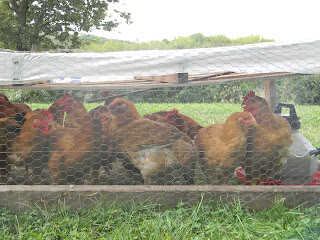
Several of you thought we were being naive to think our chickens would not damage our garden! Several weeks ago it became obvious that they were not going to stay in the pasture without encouragement! We've been using our movable chicken pen for several weeks now and we are quite pleased with the results of this easy project!
Ed took a piece of the plastic water tubing left from our strawberry netting project and made two large circles of equal sizes. These tubing circles were attached to the top and bottom of a piece of cage wire. He cut the wire about every foot and bent the wire over the tubing and secured with plastic ties. We now had a sturdy movable pen! Ed cut a door to meet up with the little chicken door of our coop and used a little bungee cord to secure it. A tarp was attached to the top to provide shade.
Each morning, Ed pulls the pen over to the coop and opens the chicken house door. The chickens are usually quite eager to have fun outdoors. Ed then drags the pen to a spot of fresh pasture grass and places their water jug inside the pen. Usually halfway through the day I move the pen a few feet to fresh grass. The pen is light enough for the children to move and the chickens have learned to hop along! In the evening, or whenever we want the chickens to return to their coop, we tilt the pen up and the chickens madly dash for the coop and their waiting grain!

Maybe this sounds like lots of hassle! Why not just let the chickens in the coop? We are finding that the chickens eat less grain when on the pasture. The grass where their pen was sitting is eaten short in those few hours and is well manured! The next day we sit the pen in the next plot of grass in hopes to evenly distribute the manure. So we are buying less grain, hauling less manure out of the coop and the chickens are not eating our garden! Occasionally we let the chickens run free for an evening when we are near by to watch the garden. Once our chickens begin laying eggs, hopefully in only a few weeks, we will let them in the coop all morning in hopes that they lay their eggs in the nesting boxes. There is numerous other chicken tractor designs including ones with nesting boxes. Our goal was something simple, temporary, and light weight. In the past couple weeks our pen has been tested in torrential rain and hail, and held up well!
Just a note: The photos in this post were taken on a day that only six of our twenty chickens were in the pen!

Monday, June 8, 2009

Rooster Update

I know you just can't wait to hear more about our chickens! The big news is that our roosters are learning to crow! A little while back, we heard some strange croaks and squawks from the chicken coop and figured one of the roosters had found his voice box but it was not going so well! A few days later I left the chickens out in the early morning. As they did their normal mad dash for the thicket, one of the Black Australorp roosters stopped, stood on tip-toe, and left out a real honest "Cock-a-doodle-doo"! I was as proud as a mama watching her toddler take his first step!
We still need to get rid of a few roosters. Two have found new homes, and one we found dead in the coop one morning. (Any ideas of what happened?) We now have four Black Australorps and three Partridge Rocks left. We may try taking some to auction this week just to give the others more room. We never planned to have this many chickens in the coop. The roost rail is rather full.
The chickens have been coming in the garden more this week. I enjoy watching them scratch in the compost pile and stand on the fence. They haven't done much damage but Ed has convinced me they are snipping off the young corn tops. He thinks we will need to begin penning them in. Yesterday Ed built a simple movable pen. Give us a few days to use it and see what we think of our design. Then I'm sure we'll be sharing about it here!

LinkWithin

Related Posts with Thumbnails