Tuesday, March 22, 2011

Bread Baking - Shaping Loaves

I'm not sure I can describe in words how to shape a loaf of bread. I'd much rather have you all over and show you! It is so much easier then it sounds. But I'll give an attempt and hope you ask questions if it doesn't make sense.

There really is no wrong way to form a loaf of bread. I enjoyed seeing different methods described in various cook books. You can find lots of online videos where you can watch the professionals shape a loaf. But here is how I do it.


Loaf Bread

You really can just pull off a ball of dough, place it in your bread pan and smooch it into the corners. But here is the way I form a loaf that seems to result in a smooth evenly shaped loaf (most of the time).

First divide your dough into as many loaves as you plan to make. Cutting the dough with a knife is better then pulling it apart, but both work. Grease your bread pan. I find that solid shortening like Crisco, lard or butter works better because oil is just absorbed in the dough. Slightly grease your counter top with some oil. You may flour the counter if you like but I prefer oil.

With a rolling pin, roll your dough flat, pushing out the air bubbles. My goal is to make the dough about as wide as my bread pan, and as long as can be easily rolled.
Roll up the dough from the short end, squeezing the dough together with your fingers as your roll.

Then, tuck the ends of the dough tightly underneath.

Place it in the greased bread pan, seam down.


Smash the dough down into the corners, until it's well flattened. Now you are ready to sit the dough in a warm place to rise! (The whole process took you much longer to read then it ever takes me to actually do it!)


Long Loaves


I use this method when making a loaf with a soft crumb such as Miracle Bread. I would not use this method if using an hearth style bread with large irregular holes.


Roll out the dough into a large rectangle, squeezing out the air bubbles.


Roll up the dough beginning on the long side. When rolled, squeeze the seam tightly to seal it and place the dough seam down on the greased baking sheet.

Slit and garnish as desired (a topic for another post).
 
Round Loaves


This is the method I use for a hearth style bread. I couldn't figure out how to take pictures since it is a two hand process. Maybe if Ed is home someday when I'm baking, I'll have him take pictures and add them to this post. 

Divide dough into as many loaves as desired. Oil your hands and pick up one lump of dough. 

Form into a ball by stretching the surface of the dough and pulling around to the bottom. Keep rotating the ball in your hands and stretching until you have a smooth ball on top. 

The idea is for the top of the dough to be taunt so that the bread will raise up and not out. The bottom with be lumpy. You want to use a firm but gently hand. You don't want to squeeze out all the air bubbles but neither do you want the dough to be flacid. 

Place the ball of dough onto a greased pan seam side down OR in a very well greased bowl seam side up. 

Did that make any sense? 

Other Loaves

The sky is the limit when it comes to shaping loaves. It is fun to braid bread, spiral, shape baguettes, etc. 

The great thing about shaping a loaf of bread is that if it doesn't turn out just like you imagined,  you can slice it before placing on the table and no one will care if it doesn't look perfect because they will be enjoying the taste! But there is something fun about pulling out a picture perfect loaf and your shaping technique will improve with practice.

Monday, March 21, 2011

The Walls Go Up

Big changes with our house addition this week.


For a refresher, this was the "before" shot.


Week One

Week Two

Week Three


On Monday, my brother came over and helped Ed finish the heat system in the floor. It took quite a while to make double sure they had no leaks. There would be no going back and fixing a hole once the floor was poured.


On Tuesday the whole crew came to pour the floor. Notice the onlookers at the door. The children have a front row seats to all the action.


Two of the guys stayed for the day to work on the concrete. I'm learning as much as anyone about the construction process. I had no idea that concrete took so many hours of troweling. The children liked the power trowel the best! In between waiting for the concrete to set up, the guys stacked our woodshed full of firewood!


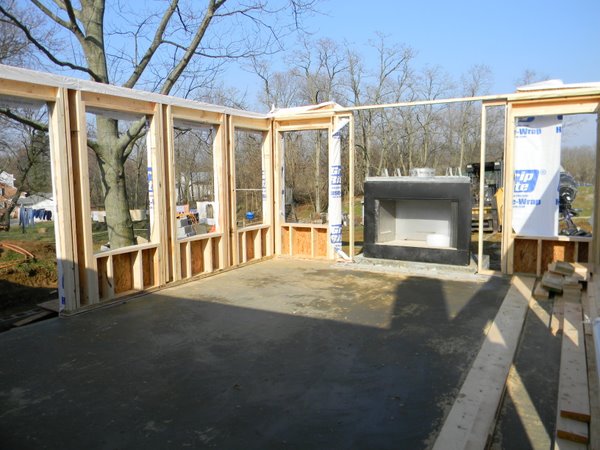
On Wednesday all the men were back to put up the walls. Now it truly begins to look like something!


My mom and sisters came and brought lunch.  My family is always ready to enjoy  food together.


We've been planning and saving for this addition for a number of years and Ed has been watching for good deals on building material. The windows and the fireplace came from Craig's List. We were able to get a much larger fireplace than we originally planned. This thing is big enough to roast a pig - well, a baby pig. With Ed's love of wood and fire, I'm hoping to enjoy some Dutch Oven meals from this fireplace!


And the good price on windows means much of this addition will be surrounded by windows! Yeah, for sunlight!


For those who have asked "what will the addition be?" maybe now I can show you a basic floor plan. The addition will be a family room. We plan to tear out the wall at our dining room  to extend a table into the new room when we have guests.


A porch on the side will function as the entrance to our home. If you've been to our house, you know how much we hate the narrow steep flight of steps to our front door. We plan to just avoid the front steps and use this entrance instead.


A small mudroom is maybe my favorite part of the addition, which may sound unreasonable...


...until you see the mud in our yard. If you have children you probably don't need much imagination to visualize what my children's clothes look like these days!


The children think the addition is the perfect play ground.


Saturday, Ed worked on laying up more block for the chimney. We had a couple warm sunny days this week and it even dried out the garden enough to plant some peas.

Next? The roof!

Friday, March 18, 2011

What To Do With Botched Bread

I have some experience with using bread flops. Whether it didn't rise,  the salt was forgotten,   pulled out of the oven too soon and sunk, or just sat on the counter too long and turned stale- I seem to have numerous loaves that for some reason are not edible for the purpose they were first created.

I try to see each flop as one more chance to learn something about bread baking. If ever I felt I was qualified to write about bread baking - it is when I consider the vast number of chances I had to learn "what not to do".

But no matter how bad the flop, don't throw it out and waste the ingredients. There is usually a way to salvage a loaf. Unless it is burnt to ashes or turned green with mold - then it is chicken food in my opinion!

Here is five ideas for those flopped, stale or dry breads or even the crusts of a good loaf if your family doesn't prefer the heel. I usually keep a bag (or two or three) of old bread in the freezer, adding to it until I get a big pile. Then I clean out the freezer of all the old bread and make something (or two or three somethings) with the stash.
  • Bread crumbs. Doesn't get any simpler than this. Place some dry bread in the blender and turn into crumbs. I keep a container of bread crumbs in the freezer to use in meatloaf, to bread chicken or as a topping for casseroles.
  •  French Toast. French toast is an excellent way to use stale bread, especially egg rich breads like challah. Slightly stale bread actually works better for french toast because it doesn't disintegrate when dipped in egg and milk.
  • Croutons. Another great use for crusts and stale bread. Readers shared some of their favorite croutons recipes here. I'll make a big batch of and keep in the freezer for salads.
  • Filling. My husband loves turkey and filling and we don't reserve it for only Thanksgiving, in fact we are having it tonight! I keep cooked chicken or turkey in the freezer to make this a quick meal. Filling (or stuffing or dressing depending on your area) can be made with any kind of bread. Mine is often a mixture of cornbread, biscuits, rolls - you may even find a waffle. With all my sourdough experiments (and failures) in the past year, my sweet husband now says that sourdough bread makes the best filling! My mom's wonderful filling recipe is here.
  • Bread Pudding. Nothing like bread pudding to make me feel like a visit to Grandma's house. Funny, I don't even remember eating bread pudding at Grandma's but it just seems like something she would make. It is another good way of using up old bread but I found out that it is best NOT to use sourdough in bread pudding. 
I love that old bread doesn't need to be wasted. Do you have any other ideas that I missed?

Wednesday, March 16, 2011

Secret of Crispy Crust Pizza


One thing about pizza that has always discouraged me is getting the bottom crust crispy. I can get the edges good but the middle is usually a soupy mess. Definitely needs eating with a fork.

I've tried pre-baking my crust before putting the toppings on. It helps but I hate the extra step.

I used less sauce, cranked up the heat, tried different pans - and nothing really made a difference.

I know the pros often suggest a pizza stone. It may be the secret but I don't have one.

When talking to my sister-in-law the other week, she suggested baking lower in the oven. Why didn't I ever think of it? But would it work? It does!!!

I used my basic pizza crust with all whole wheat flour. I used my usual toppings and baked for the same amount of time at the same temperature. I placed the oven rack as far to the bottom of the oven as possible.


The crust was astoundingly different! It was crispy! This was pizza you could pick up and eat in the hand! Ed loves the change. I've baked the pizza this way for several weeks now and I'm never going back!

Simple solution to a problem I've had for years!

Monday, March 14, 2011

Men At Work

The past week has seen some progress on our house addition.


On Monday we woke to a lovely snowfall. Combined with several inches of rain, our yard was a soggy sponge.


But like our usual March snowfalls, this one was mostly gone by the next day. On Tuesday the whole crew came out. Ed took the day off work, my construction brothers, their employee, plus my farming brother and my dad all came to help lay the block for the foundation.


If you know my family, you know that there was lots of fun in the midst of working.


The men were great at allowing the children to "help". I didn't even try to have school!


This week was rather crazy. Besides keeping up with his normal job, Ed was attempting to help with the house. To top it off, we were having a week of revival services at our church. It was an exhausting week, but a very good one. Our evangelist has a passion for God and we thoroughly enjoyed the services. It is easier for me to show pictures of our building projects than to put into words the work the Lord did in my heart this week. Hopefully, by the grace of God, my heart change will be far more lasting than these walls.

In a crazy coincidence, the minister for our revival services is the same man who taught my brothers much about  construction. One of the advantages of our church's way of calling a minister from amongst the congregation in contrast with a salaried career pastor is the ability to watch your ministers live out their faith and ministry in their every day life and occupation. The fact that my brothers came to hear John preach this week is a testimony to the impact he has had on their lives.


Back to the building project...by the end of the day, the walls were up and ready for inspection.


On Wednesday, the inspection passed and one of my brothers came to help Ed back fill. This was crazy since the rain had turned the clay turned to a slimy soup. Trying to pack this stuff down was nearly impossible. The skid loader was stuck  many times.


I thought they'd never get it done, but they did, despite the fact that it began raining again. I couldn't believe how neat the foundation looked now covered in stone and leveled.


As expected, operating machinery on soft grass is having an effect. The pictures really can't show how bad it looks. Imagine a smeary mud lot and you might be close.

It probably sounds like I'm complaining. But really I'm just stating the facts. I told Ed from the beginning that I'm okay with having a ton of landscape and grass seeding to do when they are finished. After last year's drought, I hope to never ever complain about rain again.

And rain we had. We don't have a rain gauge up but it is no exaggeration to say that we received several more inches on Thursday.

On Saturday, Ed's brother and nephew helped finish a few more block and lay down the insulation. We plan to have radiate heat in a concrete slab floor, so they placed some of the tubing.

Next up- pouring the concrete floor. Hope the concrete truck doesn't get stuck!

Thursday, March 10, 2011

Whole Wheat Bagels


I've been wanting to get my bagel recipe perfected. I have several recipes I've used at various times. Some use a pre-ferment stretching the process out to two days. Other recipes were mostly white flour and I wanted to use whole grains.

I've been making bagels every Saturday for the past couple weeks and think I have it down perfect. At least, Ed says these are good enough to continue as a Saturday tradition! He is one person (and my children count for four more) that isn't complaining about my baking binges!


You can use white flour if you prefer. You'll probably use slightly more than five cups of flour if using white flour.

Bagel dough is just a basic bread dough which contains no fat and is rather stiff. The uniqueness of a bagel is placing them in boiling water before baking. This stops some of the yeast action which makes for the chewy texture that we love in a bagel.

I've almost completely stopped using extra gluten in bread doughs but I do still add a little to bagels. But it is optional. 

We like to split the bagels, butter them and place on a baking sheet under the broiler for a few minutes. It is a fast way to toast bagels for the whole family. Add cream cheese and you have a yummy breakfast! We also love bagels as the base of an egg, ham and cheese sandwich. Mmmm!


Whole Wheat Bagels


2 1/4 cup warm water
2 T honey
2 tsp yeast
5 cups flour
1 T vital gluten (optional)
2 tsp salt

Combine all ingredients. Mix well. Allow dough to rest for 10 minutes. Mix dough, adding more flour if needed. The dough should be easy to handle and not too sticky. Knead for 10 minutes.

Place dough in a greased bowl and allow to raise until double (about an hour). An alternate method is to place the dough in a covered bowl in the refrigerate overnight. This helps develop the flavor of the dough - plus makes less work on the day you plan to bake.

After the dough is risen, (or when you take it from the refrigerator) divide in 12 balls (or smaller if you wish) You may also add any additional ingredients at this time such raisins and cinnamon. (more information at the bottom)

I form bagels by rolling the dough in a smooth ball then pushing my fingers through the center and stretching. The center hole will need to be rather large since when the bagel rises, the hole will decrease.


Cover the bagels with plastic wrap or a damp towel and allow to rest for about 20 minutes. If the dough is cold, it may take slightly longer. You don't want them to over rise. To test if the bagels are ready, drop a bagel in a bowl of cold water. They are ready to bake when the bagel floats. There is no need to test them all. When one bagel "floats" they are all ready.


While the bagels rest, prepare your boiling water. In a large pan, place about 2 quart of water and 1 T baking soda. Bring the water to boil. Drop your bagels in the boiling water. Depending on the size of pan, you can boil several bagels at a time. They should immediately float. Boil for one minute. About half way through, I turn the bagels over.

Remove bagels from water and place on a baking sheet. Bagels are notorious for sticking to the pan. I like to use parchment paper or a silicone baking mat. If you have neither, grease the pan well. They won't rise much in the oven, so you can place the bagels close together.


If you wish, sprinkle bagels with sesame seeds or poppy seeds before baking. You also may brush with a beaten egg white for a shiny look, though I usually don't. Bake bagels at 450 degrees for 15-18 minutes.

For cinnamon raisin bagels - For one batch of bagels, use 1 cup of raisins and 1 tsp of cinnamon. I usually divide the dough in half and only add 1/2 cup of raisins to half the batch. After raising the first time, I roll the dough out thinly and sprinkle on the raisins and cinnamon. Roll up tightly and knead briefly to incorporate the raisins. Divide and shape into bagels and proceed according to the recipe. Some of the raisins will fall out of the bagels as you boil them but I have found if raisins are not falling out, I haven't added enough raisins!

After baking, a yummy touch is to brush the bagels with butter and dip the tops in cinnamon sugar. It dries into a yummy crust - but it is also messy so I don't often take the time for this step and it is still good!


Hope you try them! Right now, this is my favorite recipe on this blog - and that is saying a lot since I have shared LOTS of favorite recipes!

LinkWithin

Related Posts with Thumbnails